Canadian home comparisons
Condo vs Townhouse in Canada: Ownership, Costs and Lifestyle
Compare condo and townhouse interiors, exteriors, floor plans, ownership, associations and monthly costs before choosing a home in Canada.
BestRealEstateAgency Editorial · Reviewed October 28, 2026
The short answer
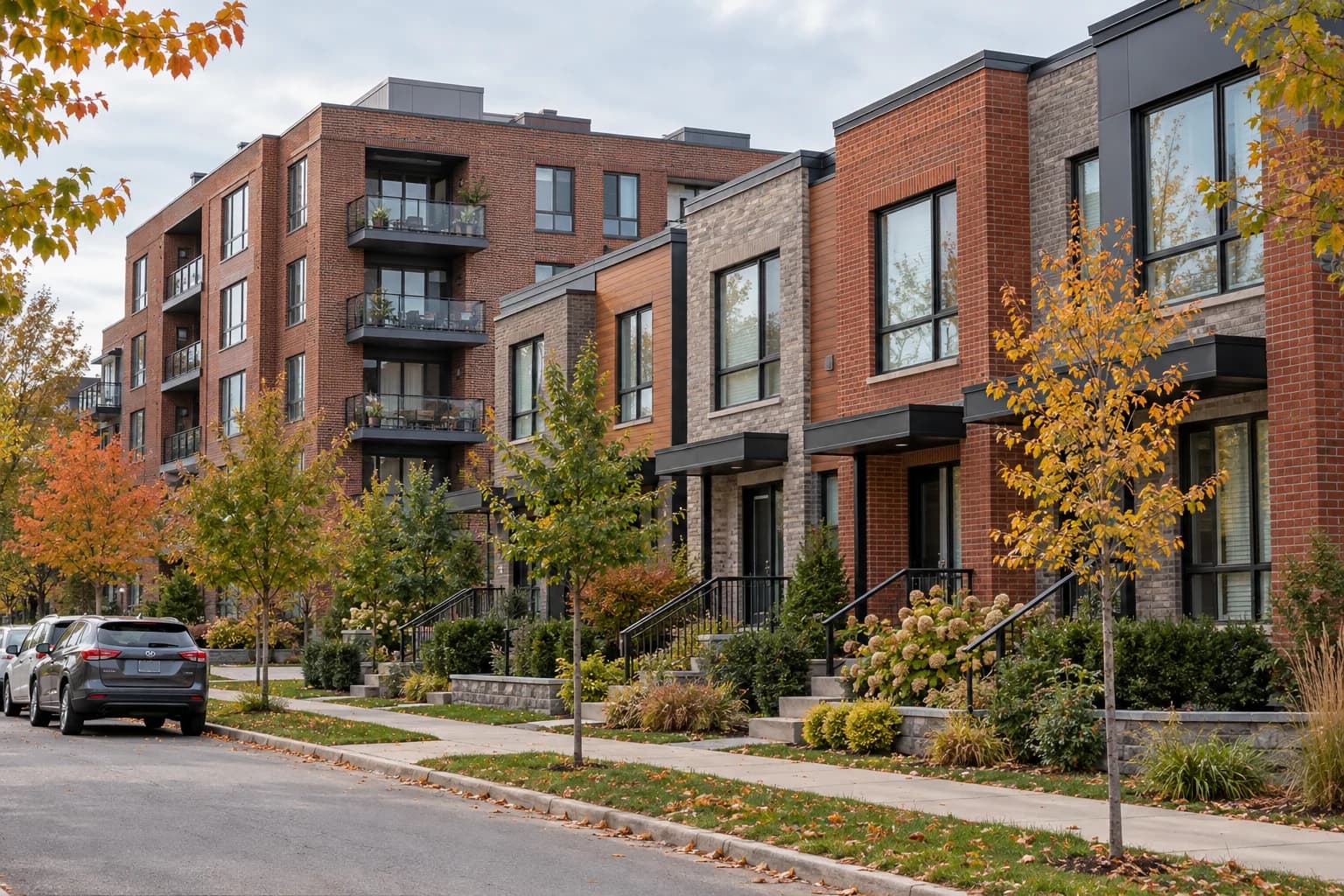
A condo describes an ownership structure; a townhouse describes a building style. A townhouse can be a condominium. For a useful comparison, separate apartment-style condos, condo townhouses and non-condominium freehold townhouses, then compare the actual homes and their documents.
| Compare | Apartment-style condo | Condo townhouse | Non-condo freehold townhouse |
|---|---|---|---|
| Layout | Usually one floor in a shared building | Often multiple floors; sometimes stacked | Usually an attached home with its own entrance |
| Interior space | Often single-level; storage and usable space vary | Often several levels; stacked plans can have upper or lower neighbours | Often several levels; more direct control over interior upkeep |
| Ownership | Unit plus an interest in common property | Unit plus an interest in common property | Home and land, subject to title obligations |
| Monthly shared charges | Condo or strata fees | Condo or strata fees | May have shared-service or common-element charges |
| Maintenance | Split between owner and corporation | Split depends on boundaries and governing documents | Owner generally arranges work; shared obligations may apply |
| Exterior decisions | Building-wide approvals may apply | Yards, roofs and exterior changes follow the documents | Permits, title restrictions and shared agreements still apply |
| Governance | Condo corporation or strata corporation | Condo corporation or strata corporation | May have a separate homeowners association or shared-service agreement |
| Outdoor space | Balcony or shared areas, if provided | Patio or yard may have use restrictions | Lot size and permitted use vary |
| Best starting question | Is the building well managed? | Who repairs each exterior component? | What shared costs and access rights affect the lot? |
Use this as a starting framework. Ownership, repair duties and permitted use depend on the property documents and the province; verify them for each shortlisted home.
Condo vs townhouse lifestyle: what changes day to day
In an apartment-style condo, an ordinary trip can involve a hallway, an elevator and a shared entrance. That may be convenient if the building has reliable step-free access, parcel handling or amenities you actually use. It can be frustrating if your routine involves repeated dog walks, hauling sports equipment or waiting for a busy lift. Check the full route from the unit to the street, not just the lobby.
A townhouse may put your front door closer to the pavement, car or patio. You may gain a place to leave muddy boots, separate bedrooms from evening activity or step outside without crossing a shared lobby. The trade-off can be more internal stairs, several small levels rather than one large living area, and outdoor chores. A stacked townhouse can still have neighbours above or below.
Privacy is about the actual home: sightlines into windows, sound through walls and floors, traffic outside, and where neighbours gather. Amenities and a garden can both be valuable, but only if you will use them. Visit at a realistic time and walk the routes you would take for groceries, transit, childcare and exercise.
- Working from home: test a closed-door workspace, call noise and the route between bedrooms and living areas.
- Children or visiting family: check play space, stair safety, stroller storage and where an overnight guest would sleep.
- Pets: check the applicable rules, the nearest suitable outdoor route and how many stairs or lift trips each walk requires.
- Hosting: compare usable dining space, visitor parking, guest access and noise expectations.
- Travel: ask who can access the unit in an emergency and what you must arrange during a long absence.
- Winter: follow the route from parking with bags and check who clears each set of steps or walkway.
Which fits your household and the next stage of life?
Someone who values a single-level layout and wants fewer exterior jobs may prefer an apartment-style condo. Someone who needs bedrooms on a separate floor, direct outdoor access or space for equipment may prefer a townhouse. These are reasons to shortlist a property, not rules about which age group or family belongs in it.
For downsizing, compare the work you stop doing with the storage and privacy you give up. For a growing household, check whether the rooms still work if a bedroom becomes a nursery, a relative stays or two people work from home. A staircase you enjoy today may become a constraint later; an elevator only helps if the whole route is accessible.
- Prefer a condo if the actual building services reduce tasks you dislike and the layout meets your space needs.
- Prefer a townhouse if its entrance, room separation and outdoor space improve your normal week enough to justify the stairs or upkeep.
- For either type, choose a property that works on a busy weekday, not only during a tidy weekend viewing.
Condo ownership vs townhouse building style
A front door at street level does not tell you who repairs the roof. Neither does the listing label “townhome.” Ask for the legal property description and a plan showing unit boundaries, common property, parking and outdoor areas. A yard available for your exclusive use may still have restrictions on landscaping or alterations.
A townhouse can be a condo, so first establish the ownership structure and then compare the building and its floor plan. CMHC’s condominium basics explains why legal unit boundaries and shared ownership matter.
Interior differences: space, noise and renovations
An apartment-style condo often places the kitchen, living area and bedrooms on one level. A townhouse often spreads that space across several floors. Neither label guarantees a bigger living room, more storage or better finishes. Compare room dimensions and the usable wall space after doors, columns and circulation are accounted for.
Listen for noise from adjoining units, the hallway, elevators and mechanical equipment. A townhouse may share only side walls, but a stacked townhouse can have a home above or below it. Construction and layout matter more than a promise that every townhouse is quieter.
Before changing flooring, moving plumbing or removing a wall, check the approval process and whether the work affects shared systems or structural components. Condo owners should not assume that owning the interior permits unrestricted renovation. A non-condominium townhouse can still require permits and compliance with party-wall or title obligations.
- Measure space for a dining table, sofa, work area and bedroom storage rather than relying only on total square footage.
- Check the location and condition of heating, cooling, ventilation and laundry equipment, and who maintains each item.
- Ask about flooring standards, contractor access, renovation hours and required approvals before budgeting for work.
Exterior differences: roofs, yards, entrances and parking
An apartment condo may offer a balcony and shared landscaping, while a townhouse may have a patio, garden, garage or private-looking entrance. A feature’s appearance does not establish ownership or maintenance responsibility. Confirm whether an outdoor area is part of the unit, common property or an area reserved for exclusive use.
For each shortlisted property, ask who maintains and replaces the roof, exterior walls, windows, doors, deck, driveway and fencing. Split maintenance from replacement: the same party may not handle both. Ask who pays after damage and which insurance policy responds. The Condominium Authority’s explanation of common elements is an Ontario example of why governing documents matter.
An owner who pays to maintain a yard may still need approval to install a fence or change landscaping. For non-condominium townhouses, check shared driveways, drainage, easements and private-road agreements before assuming the owner has complete exterior control.
- Confirm parking and storage rights; a numbered space is not necessarily separately owned.
- Check snow clearing, lawn care, waste access and the route from parking to the front door.
- Ask about approvals for a barbecue, EV charger, satellite dish, deck or exterior colour change.
Floor plans: compare how the rooms work together
A typical apartment-style condo may suit someone who wants the main living spaces on one level. A conventional townhouse may put living areas on one floor and bedrooms on another. Stacked and back-to-back townhouses can have very different entrances, stair runs, windows and outdoor access, so view the actual plan rather than treating all townhouses as one layout.
Trace a normal day through each plan: groceries from parking to the kitchen, laundry to the bedrooms, a visitor reaching the bathroom, and a child or older relative getting to an exit. Count entry stairs as well as stairs inside the home. An elevator in the development does not guarantee a step-free route to every unit.
Listing floor plans help compare furniture placement, but they do not establish legal boundaries or replace measurements and document review. Distinguish interior living space from balconies, garages, unfinished areas and stairs, and check how the advertised area was measured. If the space you need points toward a detached property, compare the interior space and maintenance trade-offs of a condo vs house.
- Look for usable bedroom widths, privacy between bedrooms and space for a home office.
- Check window placement, natural light, ceiling height and whether a lower-level room meets your intended use.
- Map the space needed for a stroller, mobility aid or future accessibility changes.
Compare total costs, not just the monthly fee
A fee-free listing does not mean maintenance-free ownership. Put mortgage payments, property taxes, insurance, utilities, parking, shared charges and a personal repair allowance on the same worksheet. Check what the fee already includes so that water, heat or insurance is not counted twice.
Use the condo fee calculator hub to explore the fee component, then replace any defaults with the listing’s actual budget. Set aside separate cash for repairs inside the unit and unexpected bills. A low fee deserves questions about services and future work, rather than an automatic preference.
- Ask which costs are included today and which are billed separately.
- Request current fees, the approved budget and information about planned work.
- Compare available cash after closing, rather than using every dollar for the down payment.
Condo associations, corporations and HOA rules in Canada
“Condo association” and “HOA” often appear in comparison searches, especially in US advice. HOA means homeowners association. For a Canadian purchase, identify the actual legal body rather than treating HOA as a universal name for every condominium. A condominium corporation, strata corporation and a separate neighbourhood homeowners association can have different purposes and obligations.
In Ontario, the condo corporation’s board manages its affairs on behalf of the owners; a property manager may handle delegated daily work. The Condominium Authority explains how boards work. In British Columbia, the relevant terms include strata corporation and strata council. Have the applicable provincial documents identify the body, its powers and the owner’s obligations.
A condo townhouse can have the same kind of shared governance as an apartment condo. A non-condominium townhouse may instead have an association or agreement for neighbourhood amenities or shared services, or no such arrangement. Ask whether payments are mandatory, what services they fund and whether membership or obligations are attached to title. Do not assume every Canadian townhouse has an HOA.
Read the applicable rules on pets, noise, rentals, parking and alterations before making the comparison. Ask how budgets are approved, how owners can participate, where notices are sent and how a concern is raised. For the effect of ownership structure on shared obligations, use the freehold vs condo townhouse comparison.
- Identify the corporation, association, board or council and the management contact separately.
- Request the current governing documents, financial records and information about upcoming work.
- Ask which decisions belong to owners and which the board or council can make under the applicable rules.
Condo owners: what you control and what you still pay for
A condo owner buys a defined unit and participates in shared ownership obligations; the details depend on the property structure. Owners still need to understand upkeep inside their unit, insurance, regular common expenses and possible additional assessments. Paying a monthly fee does not transfer every repair or financial risk to someone else.
Distinguish normal upkeep, damage repairs, upgrades and common-property work when asking who pays. In Ontario, the Condominium Authority’s explanation of condo operations describes how legislation and governing documents allocate duties. Ask an insurance professional how personal coverage coordinates with the corporation’s policy.
Ownership also brings a role in the community’s decisions. Learn how meetings, voting, records requests and board elections work in the relevant province. Treat management quality and financial planning as part of choosing the home, alongside its floor plan and finishes. If you are deciding whether to rent instead, the condo vs apartment guide separates tenant responsibilities from ownership.
- Ask who handles an in-unit leak, a failed window, an appliance replacement and damage to shared areas.
- Check current common expenses, planned projects, reserve planning and insurance deductibles.
- Plan cash for costs outside the regular fee, including your unit repairs and applicable assessments.
Check the building and the paperwork
For a condo or strata property, have the appropriate professionals review the financial and property records available in that province. Ask about reserve planning, major repairs, insurance deductibles, disputes and proposed assessments. Review the unit’s condition too; document review does not replace a physical inspection.
For a non-condominium townhouse, investigate the roof, drainage, shared walls, driveway arrangements and title obligations. Make a list of who arranges and pays for each likely repair, and check the inspection findings against those responsibilities.
Document names differ across Canada. British Columbia buyers will encounter strata records such as the Form B Information Certificate; Ontario buyers commonly request a status certificate. Have your legal professional identify the correct package for the property rather than applying one province’s checklist everywhere.
Resale and rental potential have no universal winner
A townhouse does not automatically appreciate faster, and a condo is not automatically easier to rent. Compare recent sales of similar properties, the competing supply, usable space, carrying costs and property condition. Ask how long comparable listings took to sell and whether the comparison includes units with different parking or fee arrangements.
For an investment, test the actual rent and expenses with the rental property cash-flow calculator. Confirm the proposed rental use before counting on that income, and compare similar units with comparable fees, parking and condition.
Choose the compromise you can live with
Shortlist an apartment-style condo if shared-building living and its services fit your routine. Consider a condo townhouse if the layout suits you and you accept shared governance. Consider a non-condo freehold townhouse if you want more direct control and can manage the maintenance responsibility.
Before an offer, use the closing-cost calculator hub to check the cash needed in your jurisdiction. Bring your two best listings and a written list of non-negotiables to an agent; ask for a property-by-property comparison, not a claim that one housing type is always better.
Who owns these homes in Canada? Age and income context
In the 2021 Census, 66.5% of Canadian private households owned their home, including condominium owners. 9.4% of all private households owned and occupied a condominium of any building type. Those condo households are a subset of homeowners, not an additional group to add to the homeownership rate.
Age below refers to the primary household maintainer, the first listed contributor to housing expenses, not necessarily the largest payer or legal owner. It is not the age of every owner or resident. These national 2021 household patterns describe who lived where; they do not tell you which home is appropriate for your age or what you can afford today.
Within each age group, who owns or rents what?
| Maintainer age | Own any home | Own an apartment condo | Own a row house |
|---|---|---|---|
| 15–24 | 18.6% | 4.3% | 1.1% |
| 25–34 | 45.5% | 7.1% | 3.7% |
| 35–44 | 64.1% | 5.7% | 4.9% |
| 45–54 | 71.7% | 4.9% | 4.7% |
| 55–64 | 75.0% | 5.4% | 4.1% |
| 65–74 | 75.2% | 7.0% | 4.0% |
| 75–84 | 72.5% | 9.2% | 3.9% |
| 85+ | 68.4% | 11.2% | 3.4% |
| All ages | 66.5% | 6.3% | 4.2% |
Apartment-condo owners here occupy condo apartments in buildings with fewer than five or at least five storeys. Row-house owners include condominium and non-condominium row houses. Census building categories do not capture every property marketed as a townhouse, including some stacked layouts.
See the age profile within each housing group
| Maintainer age | Own an apartment condo | Own a row house |
|---|---|---|
| 15–24 | 1.9% | 0.8% |
| 25–34 | 15.5% | 12.4% |
| 35–44 | 15.7% | 20.4% |
| 45–54 | 13.8% | 20.0% |
| 55–64 | 17.2% | 20.1% |
| 65–74 | 17.8% | 15.7% |
| 75–84 | 12.6% | 8.1% |
| 85+ | 5.4% | 2.5% |
Income context: household income, not a salary requirement
The 2021 Census housing release reported median total household income in 2020 of $102,000 for owner households and $54,800 for renter households. These are before-tax household incomes across all home types, not individual salaries or condo/townhouse income estimates.
The age-and-property table above does not provide a matching salary breakdown. We have not assigned a salary to an age group or property type. Household income may include several earners and sources other than employment, and 2020 incomes were affected by pandemic supports. These historical medians are not a current mortgage-qualification threshold.
Adapted from Statistics Canada, 2021 Census, Table 98-10-0231-01: Age of primary household maintainer by tenure, Canada, all household types, household-count statistic, 25% sample data; and the September 21, 2022 housing release for 2020 income context. This does not constitute an endorsement by Statistics Canada of this product. Source household counts are rounded, so derived percentages and age totals may not add exactly. Retrieved October 28, 2026.
New-build price history by city
These public indices track changes in builders’ and developers’ new-home selling prices. They do not measure resale appreciation, average sale prices or an individual owner’s investment return.
No separate townhouse index is available in these tables. The condo line is new-condo context; the optional new-house index groups single, semi-detached and row homes together. Neither measures townhouse appreciation on its own.
Calgary: Q1 2017–Q2 2026
A full 30-year comparison is unavailable for this selection. Showing 9.3 observed years, without estimating missing history.
Some displayed source estimates carry Statistics Canada’s “E — use with caution” flag. Affected periods are marked * in the data table.
- New condo apartments
| Series | Total change | Annualized growth (CAGR) |
|---|---|---|
| New condo apartments | +5.2% | +0.5% |
View chart data
| Period | New condo apartments change |
|---|---|
| Q1 2017 | +0.0% |
| Q2 2017 | +1.5% |
| Q3 2017 | -1.4% |
| Q4 2017 | -3.8% |
| Q1 2018 | -5.0% |
| Q2 2018 | -8.5% |
| Q3 2018 | -8.2% |
| Q4 2018 | -11.8% |
| Q1 2019 | -14.8% |
| Q2 2019 | -16.4% |
| Q3 2019 | -17.8% |
| Q4 2019 | -20.9% |
| Q1 2020 | -22.7% |
| Q2 2020 * | -22.7% |
| Q3 2020 | -23.2% |
| Q4 2020 | -22.1% |
| Q1 2021 | -22.0% |
| Q2 2021 | -21.3% |
| Q3 2021 | -20.2% |
| Q4 2021 | -19.8% |
| Q1 2022 | -19.8% |
| Q2 2022 * | -18.8% |
| Q3 2022 * | -18.3% |
| Q4 2022 | -17.9% |
| Q1 2023 | -16.6% |
| Q2 2023 * | -13.1% |
| Q3 2023 * | -7.7% |
| Q4 2023 * | -4.1% |
| Q1 2024 * | +1.4% |
| Q2 2024 * | +6.0% |
| Q3 2024 * | +6.6% |
| Q4 2024 * | +8.2% |
| Q1 2025 * | +8.1% |
| Q2 2025 | +7.0% |
| Q3 2025 | +6.5% |
| Q4 2025 | +6.5% |
| Q1 2026 | +6.3% |
| Q2 2026 | +5.2% |
Each observation represents a quarter, labelled at quarter end in the underlying chart data. Growth is rebased to the first observed quarter; no monthly condo estimates are interpolated.
Adapted from Statistics Canada, New condominium apartment price indexes, Table 18-10-0273-01 (Q1 2017–Q2 2026), and New housing price index, Table 18-10-0205-01 (displayed monthly history September 1996–September 2026). This does not constitute an endorsement by Statistics Canada of this product. Data retrieved October 28, 2026, under the Statistics Canada Open Licence. Census metropolitan areas are broader than city limits. Growth is nominal and excludes inflation, ownership costs and rental income. CAGR compounds the endpoint indices over elapsed months; it is not the arithmetic average of annual changes.
Common questions
Is a townhouse a condo?
It can be. Townhouse describes the building style, while condominium describes an ownership structure. Confirm the title and governing documents.
Are townhouses always cheaper than condos?
No. Location, size, condition, parking and ownership all affect price. Compare similar actual listings and total ongoing costs.
Does a condo expire after 50 years?
A building’s age alone does not establish an expiry date. Review the tenure, any underlying lease, building condition and applicable provincial rules with your legal professional.
Do townhouses appreciate as much as houses?
There is no dependable national ranking. Use comparable local sales and account for condition, supply, ownership and carrying costs.
Do townhouses have an HOA in Canada?
Some have a homeowners association or shared-service agreement, some are governed by a condo or strata corporation, and some have neither. Check the title, agreements and governing documents rather than assuming an HOA is automatic.
Can condo owners change the interior of their unit?
Some work may need approval, especially if it affects structure, plumbing, shared systems, flooring standards or other owners. Check the governing documents, permits and approval process before starting.
Who maintains the exterior of a condo townhouse?
It depends on the unit boundaries, governing documents and applicable provincial rules. Ask separately about maintaining, repairing and replacing the roof, windows, doors, yard and driveway.
Are townhouse floor plans always larger than condo floor plans?
No. Compare actual room measurements, usable space, stairs and storage. A larger advertised area may not give you a larger living room or a more accessible layout.
Are condo fees and HOA fees the same thing?
Do not treat the terms as interchangeable. Condo fees fund the applicable corporation’s shared expenses. A separate homeowners association may fund neighbourhood amenities or services under different agreements. Check whether the specific property has one obligation, both or neither.