Market Trends · Updated August 7, 2026 · 14 min read
Vancouver vs Calgary Real Estate: Cost of Living Compared in 2026
Vancouver vs Calgary real estate is the widest affordability gap between any two major Canadian cities. Calgary’s typical home costs about $569,200 against Metro Vancouver’s $1,099,100, roughly 48 percent less. Vancouver’s answer is a climate no other Canadian city can offer.
This comparison has driven sustained migration from British Columbia to Alberta for several years. Below is the full picture, starting with the numbers side by side.
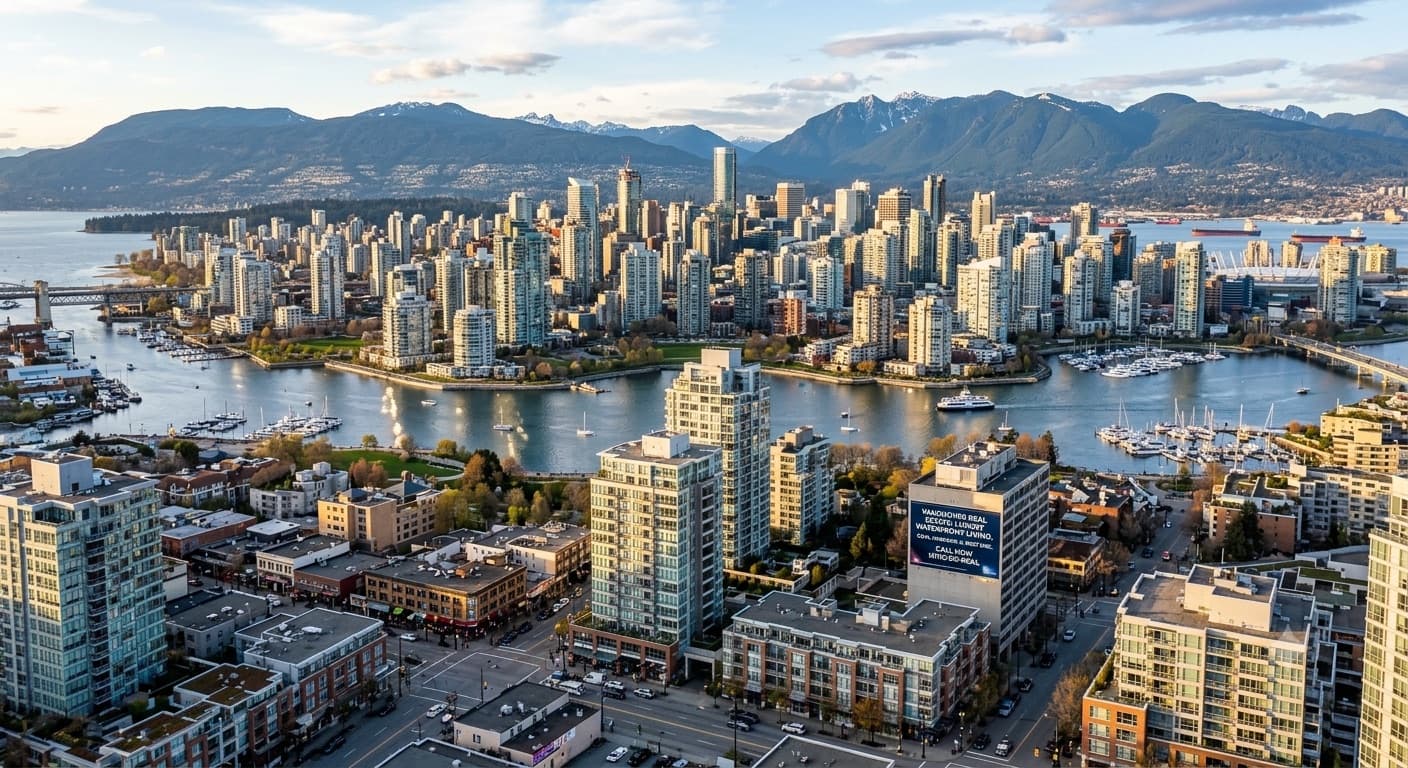
Vancouver vs Calgary at a glance
| Metric | Vancouver | Calgary |
|---|---|---|
| Typical home price | $1,099,100 | $569,200 |
| Detached home | About $1.99M | About $743,900 |
| Condo apartment | About $771,000 | About $299,000 |
| 12 month price change | Down 6.0% | Down 2.0% |
| Average 1 bedroom rent | About $2,600/mo | About $1,580/mo |
| Average 2 bedroom rent | About $3,150/mo | About $1,900/mo |
| Residential property tax rate | About 0.31% | 0.63% |
| Land transfer tax on $1M | About $18,000 | $0 (fees only) |
| Top provincial income tax rate | 20.5% | 10% flat |
| Provincial sales tax | 7% PST + 5% GST | 5% GST only |
| Adult monthly transit pass | About $110 (1 zone) | $126 |
Vancouver wins exactly one line on that table: the property tax rate, which is roughly half Calgary’s. That advantage is real but it is applied to homes worth nearly twice as much, so the dollar amounts end up comparable. On a $1,099,100 Vancouver home at 0.31 percent you pay about $3,410 a year; on a $569,200 Calgary home at 0.63 percent, about $3,590. Nearly identical bills.
The consensus figure is that Vancouver costs roughly 18 percent more overall. Numbeo currently puts Vancouver 18.4 percent higher including rent, 5.4 percent higher excluding it, and 53.0 percent higher on rent alone.
How much cheaper are homes in Calgary?
About 48 percent cheaper on the headline figure, and 61 percent cheaper on condos. Calgary’s benchmark was $569,200 in July 2026 against Metro Vancouver’s $1,099,100 in June.
Home prices by property type, 2026
Greater Vancouver Realtors, June 2026 and CREB, July 2026. Figures are MLS benchmark prices.
The detached comparison is the one that moves households. A typical Metro Vancouver detached home runs close to $1.99 million; the Calgary equivalent is about $743,900. A Vancouver owner with equity in a detached house can frequently buy in Calgary outright and retire a mortgage entirely.
The condo gap is proportionally even larger. Vancouver condos average about $771,000 against roughly $299,000 in Calgary, where years of high density completions have pushed apartment prices down nearly nine percent year over year. Calgary’s apartment segment is currently the softest in the province and the best value in the comparison.
- Detached: about $1.25M cheaper in Calgary, the largest single dollar gap in Canadian intercity comparison.
- Condo: about $472,000 cheaper, with Calgary supply still heavy and prices still easing.
- Both markets are correcting, Vancouver faster at 6.0 percent against Calgary's 2.0 percent.
What income do you need in each city?
Roughly $215,000 of household income buys the typical Vancouver home with 20 percent down, against about $120,000 in Calgary. That is a $95,000 difference in required income for equivalent housing.
Adjust the inputs to model your own situation. Note that Vancouver’s much lower property tax rate slightly narrows the gap, but nowhere near enough to close it.
Qualifying at 6.50% (stress test)
Amortization
Property type
Vancouver
Your maximum price
$685,000
Average condo costs $771,000
Short by $86,000
Needs about $168,000 household income
Calgary
Your maximum price
$655,000
Average condo costs $299,000
Within reach, $356,000 of room
Needs about $71,000 household income
Estimates use a 32% gross debt service ratio, $125/month heating, and each city’s residential property tax rate. Qualifying uses the greater of your rate plus two points or 5.25%. Condo fees, CMHC insurance on down payments below 20%, and closing costs are not included.
The typical outcome: an income that buys a one bedroom condo in Vancouver buys a detached house with a garage in Calgary. For households that want space, this is not a close comparison.
Rental comparison
Calgary is about $1,020 a month cheaper on a one bedroom, averaging $1,580 against Vancouver’s $2,600. Two bedrooms run about $1,900 against $3,150.
| Unit type | Vancouver | Calgary |
|---|---|---|
| Bachelor / studio | About $2,100 | About $1,300 |
| 1 bedroom | About $2,600 | About $1,580 |
| 2 bedroom | About $3,150 | About $1,900 |
| 3 bedroom | About $4,000 | About $2,300 |
Vancouver is the most expensive rental market in Canada, and the gap against Calgary on a two bedroom exceeds $1,250 a month, or $15,000 a year. For a household saving toward a down payment the effect compounds twice, since the target price is also roughly half.
Rent figures reflect CMHC purpose built averages. Numbeo puts Vancouver rents 53.0 percent above Calgary’s, with a one bedroom at $2,577 downtown and $2,262 outside the core against $1,867 and $1,541 in Calgary. Listing averages run higher than stock wide averages in both cities.
Vancouver’s vacancy rate has historically run extremely tight, which makes searching competitive in a way Calgary’s market is not. Calgary rents did rise sharply through the recent migration wave, but have since flattened as purpose built supply caught up.
BC property transfer tax versus Alberta’s none
British Columbia charges property transfer tax of about $18,000 on a $1,000,000 home. Alberta charges no land transfer tax at all, only Land Titles registration fees in the hundreds of dollars.
Vancouver
$14,000
BC property transfer tax
Calgary
$1,540
No land transfer tax, registration fees only
Calgary saves you about $12,460 on closing day.
Land transfer charges only. Legal fees, title insurance, inspections, and any first time buyer rebates are excluded. Alberta figures assume a 20% down payment because registration fees scale with the mortgage amount.
BC’s tax runs at one percent on the first $200,000, two percent to $2 million, and three percent above that, with a further two percent on residential value over $3 million. It is due in cash on closing and cannot be financed.
- BC first time buyers get a full exemption below $500,000 and partial relief up to $860,000, which helps at the entry level only. On a typical Vancouver condo around $771,000 the exemption is $8,000, not a wipe, so you still pay about $5,420.
- BC's newly built home exemption can apply up to $1.1 million on qualifying new construction.
- Alberta has no equivalent tax to exempt, so registration fees apply regardless of buyer status.
- BC also layers on the speculation and vacancy tax and, in Vancouver, an empty homes tax on under-occupied property.
For the cash-to-close math in each city, see the first time home buyer in Vancouver and first time home buyer in Calgary guides.
Income tax and sales tax
Alberta applies a flat 10 percent provincial rate and charges no provincial sales tax. British Columbia runs bracketed rates to 20.5 percent and adds seven percent PST on top of GST.
For a $150,000 household the provincial income tax difference is worth roughly $2,500 to $3,500 a year, and the sales tax difference adds roughly another $1,400 for a household spending $20,000 on taxable goods.
Stacked with the housing gap, these are not marginal effects. A Vancouver household moving to Calgary typically improves its annual cash position by a five figure sum before accounting for the change in mortgage size.
What salary do you need in each city?
| Situation | Vancouver income needed | Calgary income needed |
|---|---|---|
| Rent a 1 bedroom comfortably | About $93,000 | About $57,000 |
| Rent a 2 bedroom comfortably | About $113,000 | About $68,000 |
| Buy an average condo | About $165,000 | About $65,000 |
| Buy the typical home | About $215,000 | About $120,000 |
| Buy a detached house | About $370,000 | About $155,000 |
The detached line is the one worth pausing on. Buying a typical detached home in Metro Vancouver requires a household income most households will never reach, which is why detached ownership there has become largely a function of existing equity or family assistance rather than income.
Jobs and the economy
Both cities have narrower economies than Toronto. Vancouver leans on film, technology, tourism, real estate, and port logistics; Calgary on energy, agriculture, logistics, and a growing tech sector.
- Vancouver: major film and visual effects hub, strong tech presence including large US satellite offices, and Canada's largest port.
- Calgary: highest concentration of head offices per capita in Canada, energy dominant but diversifying into tech and logistics.
- Vancouver pays more on average, about $4,813 net monthly against Calgary's $4,215, so Calgary's advantage comes from costs rather than pay.
- Vancouver's structural problem is that salaries have not kept pace with housing, producing persistent outflows of people in their thirties.
- Calgary's structural risk remains energy price exposure, which affects jobs and housing together.
Total monthly costs compared
Calgary wins every household profile, and housing drives almost all of it. Calgary loses on utilities and transit, and the grocery gap is much narrower than most people expect.
- Housing
- Transit
- Groceries
- Utilities & internet
- Dining out
Mid 2026 estimates using average rents, each city’s adult transit pass, and typical grocery and utility spends. The owning profile uses a mortgage on the typical home at 20% down, 4.5%, 25 years, plus property tax and insurance.
Calgary’s heating costs are meaningfully higher given the colder winter, and its transit pass costs more than Vancouver’s one zone fare. Groceries run only about 6.2 percent cheaper in Calgary, and restaurants about 6.0 percent, both far smaller gaps than the 53 percent rent difference.
That is the pattern worth internalising: excluding rent, Numbeo has Vancouver just 5.4 percent more expensive. Day to day spending in the two cities is close to identical. Shelter is the entire story.
Getting around
Vancouver has the better transit network and the more walkable core. Calgary has far less congestion and shorter commutes.
- Vancouver's SkyTrain is fully automated, frequent, and genuinely supports car free living across much of the region.
- Calgary's CTrain is fast on its two lines but the network is thin; most communities require a car.
- Budget $600 to $900 a month for a car in Calgary unless you commit to the inner city.
- Vancouver's geography, water and mountains, funnels traffic into a few crossings and produces severe bottlenecks.
- Calgary commutes are consistently shorter, which is worth both money and hours.
2026 to 2027 market forecast
Both markets are correcting, Vancouver faster. Forecasters expect a bottom during 2026 with a modest recovery in 2027, and Calgary’s shallower decline suggests it recovers from a higher base.

Vancouver is down about six percent over twelve months, with weakness concentrated in condos and in the presale market, where completions arriving into a soft market have created genuine distress among investors who bought in 2021 and 2022.
Calgary is down about two percent, with detached supply still tight and apartments carrying the entire decline. The two markets are converging slightly, though at this gap convergence is close to irrelevant for a household decision.
Should you buy now or wait?
2026 favours buyers in both cities, and unusually so for condo buyers. Vancouver presales and Calgary apartments are the two softest segments and carry the most negotiating room.
Inventory is elevated and conditions are back in both markets. As always, the case for waiting is personal rather than market driven: job insecurity, a likely move within three years, or a down payment thin enough that insurance premiums erode your position.
Climate: mild and wet versus cold and sunny
Vancouver averages about 4°C in January against Calgary’s −7°C, but receives roughly 1,200 mm of precipitation a year against Calgary’s 420 mm. Calgary gets roughly 330 days of sunshine.
Average daily temperature (°C)
Average monthly precipitation (mm)
Environment and Climate Change Canada 1991 to 2020 climate normals. Precipitation combines rain and the water equivalent of snow.
This is the clearest trade in the comparison. Vancouver winters are mild enough that snow is an event rather than a season, and outdoor activity continues year round. They are also grey: November through February deliver long stretches of rain and limited daylight, and seasonal affective disorder is a genuine and commonly discussed issue.
Calgary’s winters are far colder in absolute terms but bright and dry, and chinook winds can lift temperatures from −20°C to +10°C within hours several times a season. Many people find the cold and sun easier than the mild and grey; many find the opposite. Visit both in January before deciding.
Mountains and the outdoors
Both cities offer world class mountain access. Vancouver adds the ocean and can ski and sail in the same day; Calgary offers the Rockies proper at roughly an hour from the city edge.

- Vancouver: Grouse, Cypress, and Seymour are within 30 minutes; Whistler is about 90 minutes.
- Calgary: Banff, Canmore, and Kananaskis are 60 to 90 minutes, with terrain and scale most Vancouver options cannot match.
- Vancouver's ocean access, sailing, kayaking, and beaches, has no Calgary equivalent.
- Calgary's dry cold produces more reliable snow conditions and a longer ski season than the coastal ranges.
- Vancouver supports year round outdoor activity; Calgary's shoulder seasons are short.
Lifestyle and culture
Vancouver is more diverse, more internationally connected, and has the stronger food scene. Calgary is more affordable, more social, and easier to build community in.
- Vancouver's Asian food scene is among the best in North America, a direct result of decades of Pacific Rim immigration.
- Calgary's Stampede and strong volunteer culture give it a civic cohesion Vancouver largely lacks.
- Vancouver is frequently described as socially difficult for newcomers, a reputation locals often acknowledge.
- Calgary's lower costs support a more spontaneous social life, since going out costs less.
- Vancouver has more international flight connections, particularly across the Pacific.
Best neighbourhoods in each city
| Looking for | Vancouver | Calgary |
|---|---|---|
| Walkable and urban | Mount Pleasant, Kitsilano, West End | Beltline, Mission, Kensington |
| Family homes with yards | Burnaby, Coquitlam, Surrey | Tuscany, Evanston, Auburn Bay |
| Best value per square foot | Surrey, Langley, Maple Ridge | Northeast communities |
| Established and prestigious | Shaughnessy, West Vancouver | Mount Royal, Elbow Park |
| Young professionals | Yaletown, Mount Pleasant | Beltline, Bridgeland |
You can browse verified agents by area on our Vancouver and Calgary city pages.
Should you move from Vancouver to Calgary?
Move if home ownership matters more to you than climate, and if your work exists in Alberta or is portable. Stay if the coastal climate, ocean access, or your specific industry is what keeps you in Vancouver.
The financial case is the strongest of any comparison on this site. A Vancouver household selling a $900,000 condo can buy a detached Calgary home outright, avoid roughly $18,000 in property transfer tax on a million dollar purchase, drop into a flat 10 percent provincial income tax, and stop paying seven percent PST.
- Move if: you want detached ownership, your work is remote or Alberta based, and grey winters wear on you.
- Stay if: you work in film, marine, or Pacific trade, or the mild climate is central to your quality of life.
- Test it: rent in Calgary for a year first. Given the rent gap this costs little and prevents an expensive mistake.
- Visit Calgary in January and Vancouver in November. Both cities are easy to love in July.
Vancouver vs Calgary: frequently asked questions
Is Calgary cheaper than Vancouver?
Yes, dramatically on housing. Calgary's typical home costs about $569,200 against $1,099,100 in Metro Vancouver, roughly 48 percent less, and Numbeo puts Vancouver rents 53 percent higher. Alberta charges no land transfer tax where BC charges about $18,000 on a $1,000,000 home. Excluding rent, though, the gap is small: Numbeo has Vancouver only 5.4 percent more expensive, and Vancouver's average net salary is about 14.2 percent higher, so the advantage is concentrated almost entirely in shelter.
Is it better to live in Vancouver or Calgary?
Calgary is better for affordability and home ownership by a very wide margin. Vancouver is better for climate and ocean access, with mild winters that Calgary cannot approach. The decision usually reduces to whether mild weather and mountains-plus-ocean are worth roughly double the housing cost.
What salary do you need to live in Vancouver versus Calgary?
A single renter needs roughly $90,000 to live comfortably in Vancouver against about $57,000 in Calgary. To buy the typical home with 20 percent down you need household income around $215,000 in Vancouver against about $120,000 in Calgary.
Why are so many people moving from Vancouver to Calgary?
Housing is the main driver, and specifically the conversion of Vancouver equity into Calgary property. A Vancouver household selling a condo can often buy a detached Calgary home outright, and Alberta adds no land transfer tax, no provincial sales tax, and a flat 10 percent provincial income tax. The move is far less compelling for renters on average local wages, since Calgary salaries run about 14.2 percent below Vancouver's. The trade is Calgary's much colder winter and the loss of ocean access.
Does Calgary or Vancouver have better weather?
Vancouver has far milder winters, averaging about 4°C in January against Calgary's −7°C, but it is much wetter, receiving roughly 1,200 mm of precipitation a year against Calgary's 420 mm. Calgary is colder but far sunnier, with roughly 330 days of sunshine and frequent chinook winds that lift winter temperatures sharply.
Is Calgary real estate a better investment than Vancouver?
Calgary offers better rental yields because entry prices are roughly half Vancouver's while rents are only about 40 percent lower. Vancouver has delivered stronger long run appreciation but is more exposed to policy intervention, including the foreign buyer ban, speculation tax, and empty homes tax. Calgary's main risk is its exposure to energy prices.
The bottom line
Calgary wins the financial comparison more decisively than any other city pair in Canada. Vancouver wins on climate and setting, and for a meaningful number of people that is genuinely worth the price.
The numbers are not close: about $529,900 less for the typical home, roughly $18,000 saved on closing at the million dollar mark, about $1,020 a month less on a one bedroom rental, a flat 10 percent provincial income tax, and no provincial sales tax.
What Vancouver offers in return is a climate and geography that cannot be replicated inland, and for some households that is the whole point of living there. The mistake is treating that preference as free. Price it honestly, then decide.
Comparing other markets? See our Toronto vs Vancouver, Calgary vs Toronto, and Montreal vs Toronto comparisons. First time buyers should start with the first time home buyer in Vancouver and first time home buyer in Calgary guides.
Keep comparing
Follow our guides as a preferred source in Google Search
- First time home buyer in TorontoDown payment, HST rebate, occupancy vs closing, and where to start
- Home inspection when buying a house in TorontoNo provincial licence, CAHPI limits, the $214.79 permit search, sewer camera
- Steps to buying a house in TorontoThe 12 steps in order: first-time tests, pre-approval, offer, close
- Pre construction vs resale condos in TorontoTarion’s $20,000 condo backstop, $52,676 to $80,690 DCs, occupancy
- Buying a home vs condo in TorontoCondo then house: market, lifestyle, location, first-time math, same tax rate
- First time home buyer in VancouverPTT after the $8,000 cap, the 92-day occupancy rule, and where to start
- First time home buyer in MontrealWelcome tax after closing, the closed city grant, and where to start
- First time home buyer in CalgaryNo land transfer tax, no city grant, and a house you can actually close
- Interactive city comparisonSwitch any two of eight markets. Prices, tax, rent, climate.
- Toronto vs VancouverPrices, rents, land transfer tax, and the 2026 forecast
- Calgary vs TorontoWhy Alberta's no land transfer tax changes the maths
- Montreal vs TorontoWelcome tax, Quebec income tax, daycare, and language
- Ottawa vs TorontoSame province, double LTT in Toronto, mill rate that almost cancels the cheaper house
- Halifax vs Toronto1.5% deed tax with no first-time rebate, and Kijiji rent is not the CMHC average
- Victoria vs TorontoNot a cheap alternative: Core houses, thirteen municipalities, 3.3% vs 0.3% vacancy
- Winnipeg vs TorontoRecord July prices, high mill rates, and $0 probate since 2020
Compare neighbourhoods
- The 25 Best Neighbourhoods in Toronto in 202625 areas with prices, Walk Scores, and boundary maps
- The 25 Best Neighbourhoods in Vancouver in 202625 areas, west side to east side, with boundary maps
- The 25 Best Neighbourhoods in Calgary in 202625 communities, inner city to lake suburbs
- The 25 Best Neighbourhoods in Montreal in 202625 areas, including how much French each one needs
- The 25 Best Neighbourhoods in Ottawa in 202625 areas, Greenbelt in or out, with boundary maps
- The 25 Best Neighbourhoods in Halifax in 202625 areas, peninsula to Dartmouth, with boundary maps
- The 25 Best Neighbourhoods in Victoria in 202625 areas across the municipalities, with boundary maps
- The 25 Best Neighbourhoods in Winnipeg in 202625 areas, walkable core to south-end new, with boundary maps